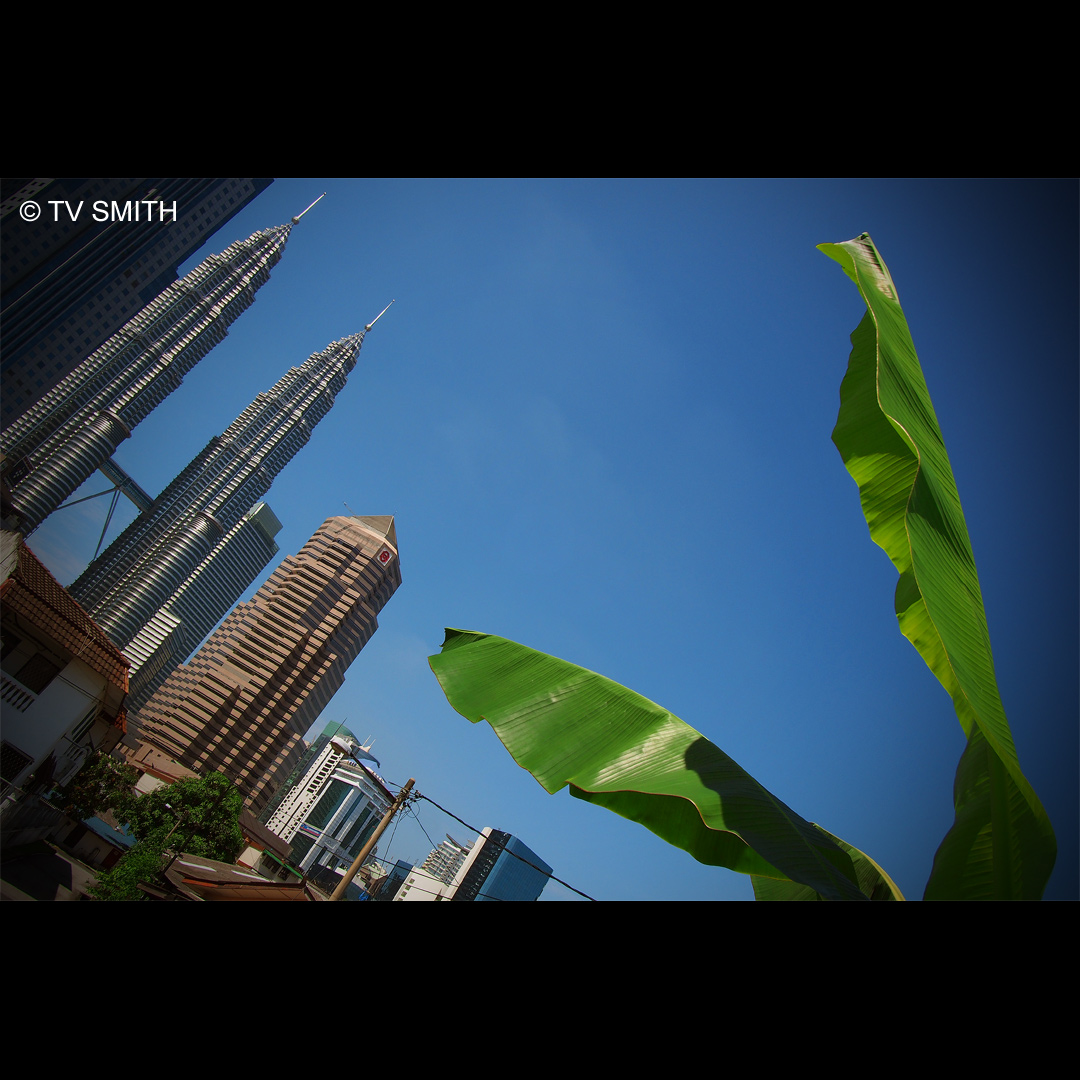
Twin Twins

Sometimes, you may want to use a tilted angle for creative effect. If you choose to slant the horizon, make it fairly obvious or it may be mistaken for sloppy framing.

One day, a hundred years from now, if this picture hang on the wall of some art gallery, an arty-farty visitor will speculate:

“The photographer wanted to convey the contrasting perspectives of urban and rural, the clash between development and conservation. The two sets of twins represent abstract symmetry but the oblique angle is a subtext of the underlying conflict…”

Actually, the reason I used the Dutch Angle here was pedestrian. I wanted to keep both the skyscrapers and the banana tree in Kampung Baru within a a single frame 🙂 There was simply no space for me to move back for a more conventional framing.

Olympus OM-D, ISO 200, f11, 1/320 sec.
Twin Twins

Staying Level

When one is awed by a seaside sunset, it is easy to overlook a basic rule in photography. Keep the horizon level. A tilted horizon is especially noticeable in pictures of the ocean. Unless it is intentional, make it a habit to level properly whenever the horizon is visible.

Even without a levelling gauge or grid lines, you can level by getting the horizon line parallel to the top or bottom edge of the viewfinder (or LCD).

Although an image editing software can rotate your image to correct framing error, it is better to get it correct in-camera. Each time you level with software, you lose part of the picture due to cropping

Make a conscious effort and after a while it will become a subconscious effort each time you pick up the camera to compose a picture.

Photographed at Bagan Lalang beach.

Olympus OM-D, ISO 200, f10, 1/320 sec.

Staying Level at Bagan Lalang

Light The Way

The Chief High Priest of Malaysia, The Most Venerable Datuk K Sri Dhamamaratana (center in orange robes) leading the 15 km Wesak Day procession through the city.

In the past, I have followed “The Chief” to photograph his many charity missions and was glad to be able to catch up with him at his office in the Buddhist Maha Vihara earlier. The busy man has a great sense of humour and reads my photoblog (occasionally). 🙂

Photography Note: There is only a tiny window of about 10 minutes when the fading blue sky and building lights combine beautifully. I was able to stress this point to the chief many years ago. Somehow, many owners of landmarks wait until the sky is pitch black before switching on the lights.

Olympus OM-D, ISO 200, f4, 1/30 sec with FL-50R Flash.

The Procession Begins