ABC

What is Ais Kacang or ABC (Air Batu Campur)? Translated as mixed ice, it was traditionally red beans, sweet corn, black grass jelly, colourful agar agar, attap chee and cendol buried in a mountain of ice shavings. The ice is topped-off with rose syrup, coconut palm sugar syrup and evaporated milk. New-fangled versions may have ice-cream, chocolate syrup, all kind of nuts and fruits. The sweet dessert is found all over South-East Asia and is known by different names.

I like the traditional version found at the PJ Old Town Market Food Court. Stall 46 or Weng Kee is one of three popular drink stalls there serving the ice dessert.

Photographing the traditional ABC is not as simple as ABC, though. You can’t see any of the ingredients when it is pristine. I ordered an extra tall one knowing it will collapse fast in the heat. The bright 4pm sun is low and superb as it rims the ice from the back, giving it a glow. The downside is the ice will melt very fast. You have like a minute or less to get your shot.

The lady boss even shouted at me to get the camera ready as she was putting the finishing touches. I like how hawkers are nowadays aware of the power of social media and are more cooperative than previously 🙂

Olympus OM-D, ISO 200, f1.4, 1/4000 sec.

ABC or Air Batu Campur

Char Kway Teow

Char Kway Teow is stir-fried ricecake strips with prawns, cockles and bean sprouts. It is a popular local hawker dish, notably from Penang. Think of it as Chinese fettuccine.

Some of the best things in life are not free nor cheap. Such as this delicious Char Kway Teow from Penang One Restaurant. But there is one thing that is still free. If you eat out in the daytime here, there is plenty of available light for food photography.

The trick is in finding the right position. Sit facing the door or window. Most people avoid it because they feel the back light may be too strong. What you want is to let the light skim the food surface and bring out its texture.

There may be a temptation to photograph a dish such as this from the top, try not to. The lower you go, the more three-dimensional the food appears. See how the bean sprouts jump out because there is depth? Let the light skim the shrimps (prawns) to make it succulent. Lai Chiak.

Olympus OM-D, ISO 640, f3.7, 1/30 sec.

Char Kway Teow

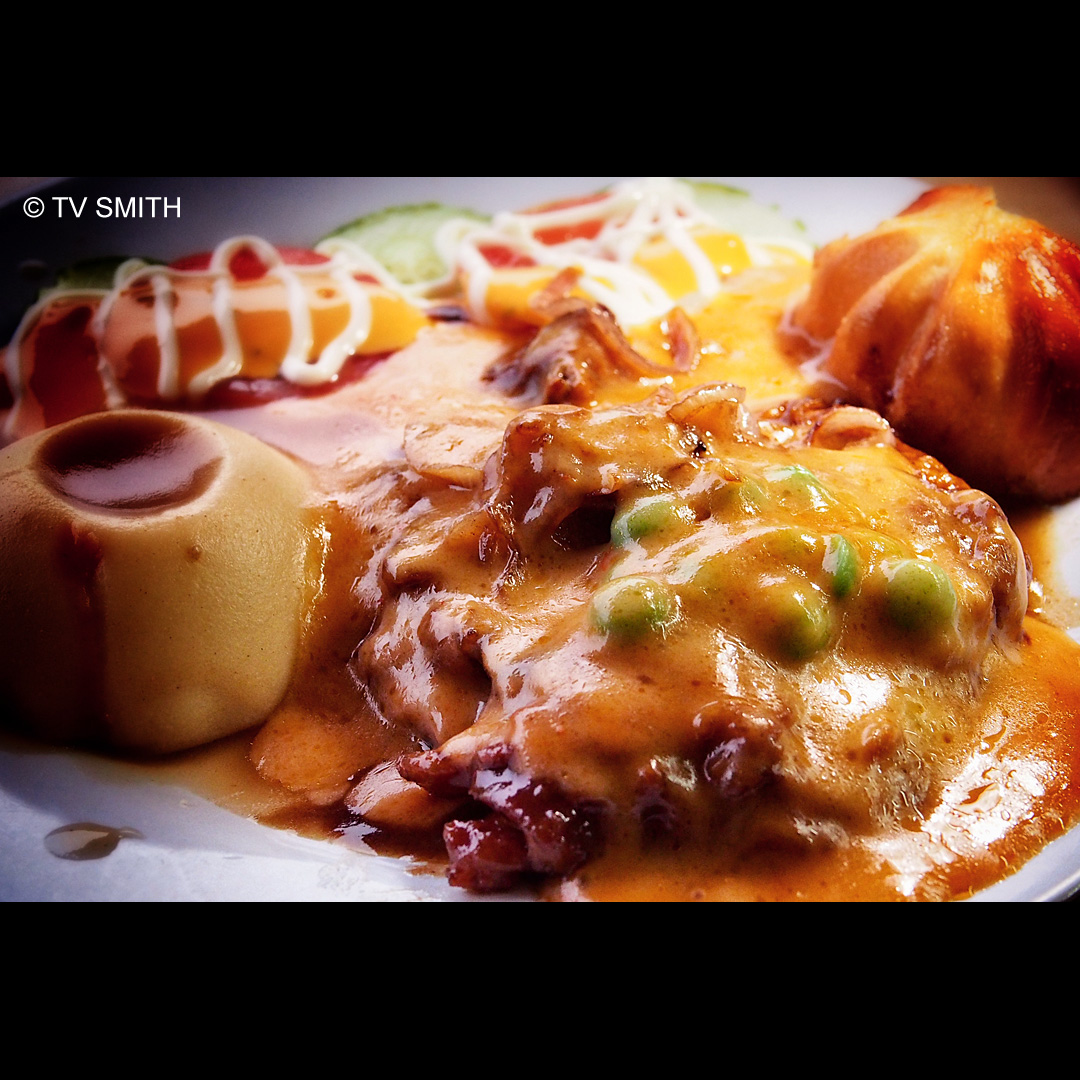
Yik Mun’s Chicken Chop

Tanjung Malim used to be a favourite stopover on the busy trunk road linking the north and south of Peninsular Malaysia. One of the coffee shops serving hungry passers-by was Yik Mun. Opened in 1926, they are known for their paus (steamed buns with fillings).

The chicken chop is uniquely Hainanese-Malaysian and Yik Mun being of Hainanese heritage serves a mean version (photographed here). Usually, it is a piece of chicken thigh drenched in a gravy made of Worcestershire Sauce, green peas, chopped mushrooms and onions, served with fries. Yik Mun’s version comes with canned green peas, mashed potato, coleslaw and a piece of mini mantou (Chinese bread). All for RM 14.

The waitress also recommended their signature Roti Kahwin (didn’t try), signature Mee Hailam (tasted ordinary), Chicken Pau (tasted bad) and Kopi O (tasted horrible). I recommend sticking to the chicken chop which was excellent. There are a couple of things that may be disturbing to some. The shop has sharks fin soup on the menu and it played Michael Learns To Rock continuously.

Yik Mun is halal.  It is now in a newer location; a maroon building at the junction to the old town and Proton City.

Olympus OM-D, ISO 2000, f5, 1/60 sec.

Yik Mun's Chicken Chop