Chinatown Walkthrough

Petaling Street in Chinatown Kuala Lumpur may be a visual treat but the traders can be a little aggressive. They do not like a camera in their face. Which is quite reasonable, considering almost every product sold there is a counterfeit. And don’t forget that nervous worker is probably a foreigner with a counterfeit work permit.

So when the Nepalese guy stuck his pinkie into his nose, I breathe a sigh of relief. It was their secret code of approval for the diminutive Olympus E-P3 camera. The illegal network of walkie-talkies crackled through the labyrinth of tarps but no one pulled out a machete. Phew! Of course, little did they know that the tiny, harmless, touristy-looking camera can produce a video with quality better than any of the fake Blue-ray discs sold there 🙂

I set out during twilight and it soon became night. The myriad range of lighting conditions gave the E-P3’s auto white balance and exposure metering a good workout. I chose to arm myself with only one lens. The new Olympus m4/3 12mm f2.0 street videographer’s lens. The low light capability of this combo is quite amazing, as you will see.
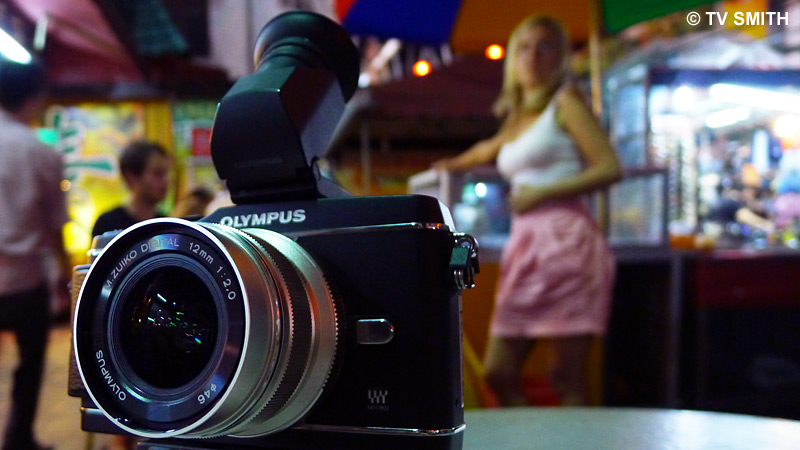
The new Olympus Pen E-P3 & M.ZD 12mm f2.0 lens. Backpacker-friendly too

The new Olympus Pen E-P3 & M.ZD 12mm f2.0 lens. Backpacker-friendly too

Those unfamiliar with this KL landmark, may find the following trivia interesting:

The messy peanut pancake (kuih apam balik) hawker is sort of an icon there. He is quite friendly to photographers who shoot and don’t buy.

The corner winter-melon-dried-longan drink remains the most popular stall there. See that woman with two cups.

I wanted to capture the sounds of the Chinese conversations between traders. With so many tourists from Middle East countries there, I ended up with a fascinating ambient sound track full of Arabic chatter instead 🙂

If you have a media player and a big screen HD TV, you can also download this Full HD clip from vimeo.com/tvsmith and watch it large and loud.

All pictures & videos photographed with the Olympus Pen E-P3 by & © TV Smith

A Cantonese Bonfire & A Hokkien Opera

A Hokkien Opera: Olympus Pen E-P3, ISO 200, f4.5, 1/60 sec

A Hokkien Opera: Olympus Pen E-P3, ISO 200, f4.5, 1/60 sec

I stumbled upon two interesting roadside events last night. Although both were held on the same street, they turned out to be distinctly different rituals. The first one is a Cantonese prayer session dedicated to the deity and dwellers from the netherworld, culminating with a bonfire.

The second one is part of a Hokkien religious festival celebrating the birthday of another Chinese deity. A brave opera troupe performed to a near empty house. Sadly, the Chinese opera is a dying tradition and art-form in Malaysia, making it all the more important to document.

But since this video is more of a real world test of the new Olympus Pen E-P3, the duration is kept brief. The E-P3 was paired with the new and fast 12mm (24mm in old money) f2.0 lens. The bonfire scene was actually quite dark but the camera still locked focus very quickly.

Down the street, the opera presented a different challenge. The stage lights induced visible flickering on the video. I had to roll the shutter speeds via the thumb-wheel until the ‘pulsing’ effect became minimised. Back stage, lighting was very dim but the E-P3/12mm f2 combo handled it with ease.

Sound was recorded with the on-board microphone and camera was handheld. Video footage captured in Full HD 1980 x 1080i resolution at 30 fps AVCHD.

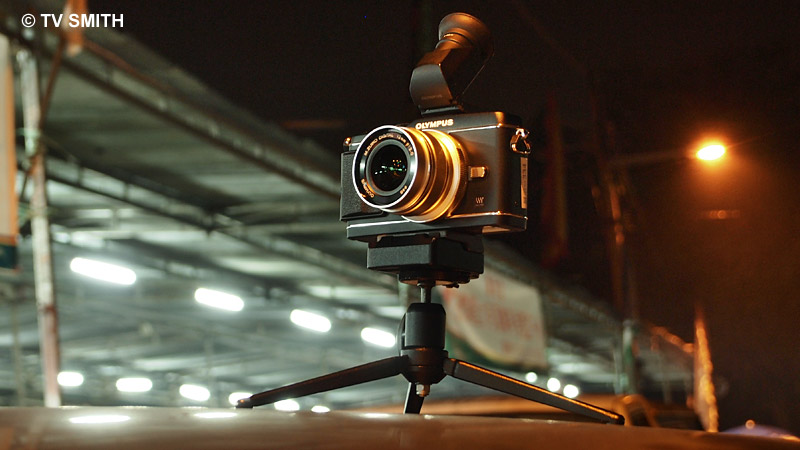
Nocturnal Warriors: Olympus E-P3 & M.ZD 12mm f2.0 & VF-2 Finder on night duty

Nocturnal Warriors: Olympus E-P3 & M.ZD 12mm f2.0 & VF-2 Finder on night duty

Full HD AVCHD is normally not easy to edit in real time, even with the very tolerant Edius Neo. However, with my new editing gig comprising an i7 CPU with 16g hyper ram and dual Corsair Force 3 SSDs, the AVCHD bully is finally beaten into a pulp.

All I need to do now is to drop all the AVCHD files from the camera directly onto the Edius timeline and it is good to go. No more conversions and messy intermediate files. The NLE will not blink, even with multiple tracks, complex 3D effects and transitions running together in real time 🙂

In this clip, only audio/video dissolves and titles were added. Output was rendered into 1920 x 1080 WMV format. Variable bit rate encoding was used for a manageable 140mb upload file size. For online screening, it is still about finding the right balance (or compromise) between size and quality…

Look out for more real-world tests, images and videos from the new Olympus Pen E-P3 and the recently introduced Digital Zuiko lenses here!