Smoky and noisy Jalan Alor is a popular ‘food street’ in Kuala Lumpur. Patronised by both locals and tourists, the stretch comes alive only after dark. For this special night-time P.O.V., I used the Panasonic Leica DG Summilux 25mm f/1.4 ASPH prime lens paired with the Olympus OM-D (EM-5).
White balance and exposure was left at Auto in P Mode while focus was pre-set manually. Audio via the on-board stereo microphones capturing ambience from both sides of the road. Rigging was handled with a Manfrotto 190 tripod with centre column mounted horizontally on the dashboard.
Resolution was set at 1920 x 1080 Full HD Fine. No colour corrections applied. Titles. trimming and WMV compression handled with Edius.
This video was made as a quick test of the OM-D’s 5-axis image stabilization and the camera’s auto reaction to changing and mixed lighting. Still image below is a screen capture from the edit timeline. Watch the video in Full HD if your hardware and network supports it.
A Hokkien Opera: Olympus Pen E-P3, ISO 200, f4.5, 1/60 sec
I stumbled upon two interesting roadside events last night. Although both were held on the same street, they turned out to be distinctly different rituals. The first one is a Cantonese prayer session dedicated to the deity and dwellers from the netherworld, culminating with a bonfire.
The second one is part of a Hokkien religious festival celebrating the birthday of another Chinese deity. A brave opera troupe performed to a near empty house. Sadly, the Chinese opera is a dying tradition and art-form in Malaysia, making it all the more important to document.
But since this video is more of a real world test of the new Olympus Pen E-P3, the duration is kept brief. The E-P3 was paired with the new and fast 12mm (24mm in old money) f2.0 lens. The bonfire scene was actually quite dark but the camera still locked focus very quickly.
Down the street, the opera presented a different challenge. The stage lights induced visible flickering on the video. I had to roll the shutter speeds via the thumb-wheel until the ‘pulsing’ effect became minimised. Back stage, lighting was very dim but the E-P3/12mm f2 combo handled it with ease.
Sound was recorded with the on-board microphone and camera was handheld. Video footage captured in Full HD 1980 x 1080i resolution at 30 fps AVCHD.
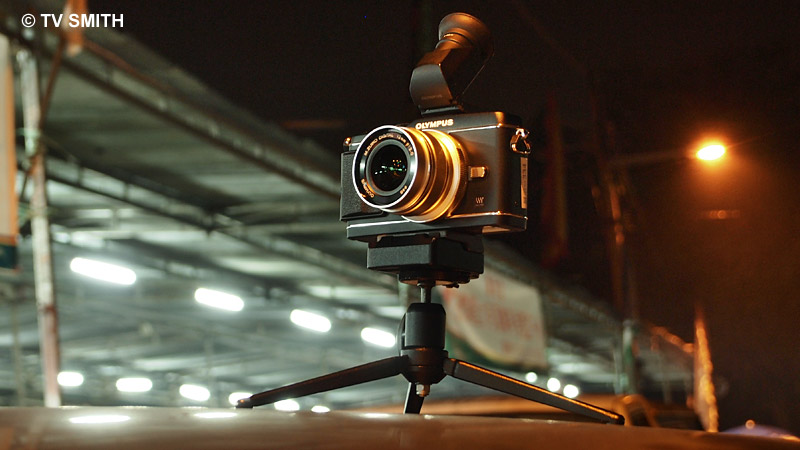
Nocturnal Warriors: Olympus E-P3 & M.ZD 12mm f2.0 & VF-2 Finder on night duty
Full HD AVCHD is normally not easy to edit in real time, even with the very tolerant Edius Neo. However, with my new editing gig comprising an i7 CPU with 16g hyper ram and dual Corsair Force 3 SSDs, the AVCHD bully is finally beaten into a pulp.
All I need to do now is to drop all the AVCHD files from the camera directly onto the Edius timeline and it is good to go. No more conversions and messy intermediate files. The NLE will not blink, even with multiple tracks, complex 3D effects and transitions running together in real time 🙂
In this clip, only audio/video dissolves and titles were added. Output was rendered into 1920 x 1080 WMV format. Variable bit rate encoding was used for a manageable 140mb upload file size. For online screening, it is still about finding the right balance (or compromise) between size and quality…
Look out for more real-world tests, images and videos from the new Olympus Pen E-P3 and the recently introduced Digital Zuiko lenses here!