Capital Nasi Dagang Kelantan

Of late, Malay restaurants serving Chinese cuisine are getting popular in the Klang Valley. However,  the reverse is less common. Thus, I was pleasantly surprised to stumble upon a Chinese shop selling authentic Malay food.

Nasi Dagang Kelantan Capital is run by a Chinese family from Kota Bharu. They have been operating in Kelantan for 9 years and opened in Petaling Jaya a month ago. I conversed with the owner, a Mr Foo, in Kelantanese Hokkien (Fujian dialect). The other option was to speak with him in Kelantanese Malay which sounded like Double Dutch to me.

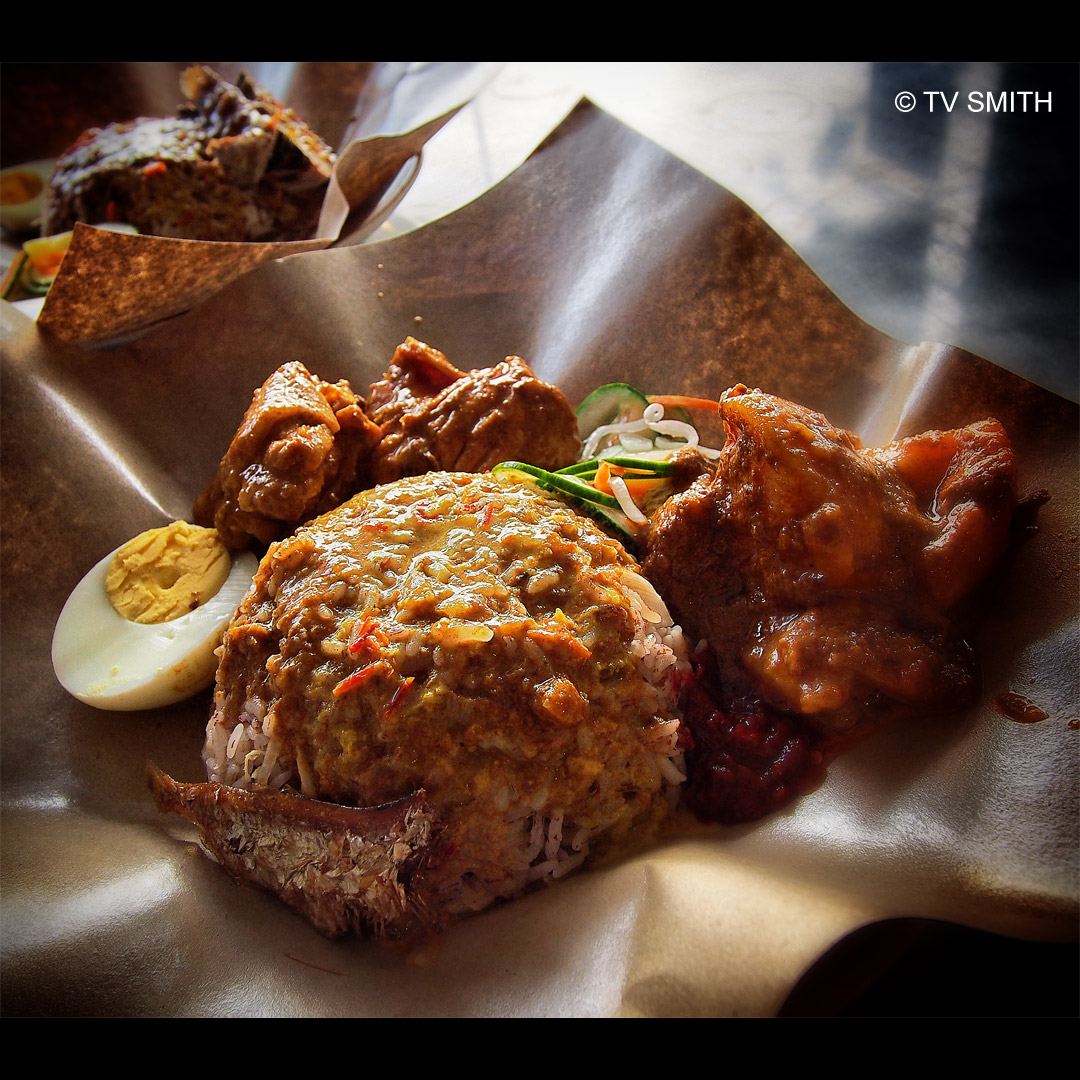
Served in waxed paper, this East Coast speciality originated from Southern Thailand. The rice is cooked with coconut milk, shallot, lemongrass and fenugreek. For the ‘lauk’, you have a choice of tasty beef rendang, curry chicken, prawn, squid or ikan tongkol (mackerel tuna).

I tried the chicken with rice soaked in gravy (photographed here) and found the combo very delicious. The condiments include a slice of boiled egg, a big piece of anchovy, salad and sambal. For buka puasa (breaking of fast), you need to takeaway before 7pm as the shop closes by that time.

Capital Restaurant is at 29 Jalan 21/1A, Damansara Utama (Uptown).

Olympus OM-D, ISO 200, f5, 1/60 sec.
Capital Nasi Dagang Kelantan

Into The Fire

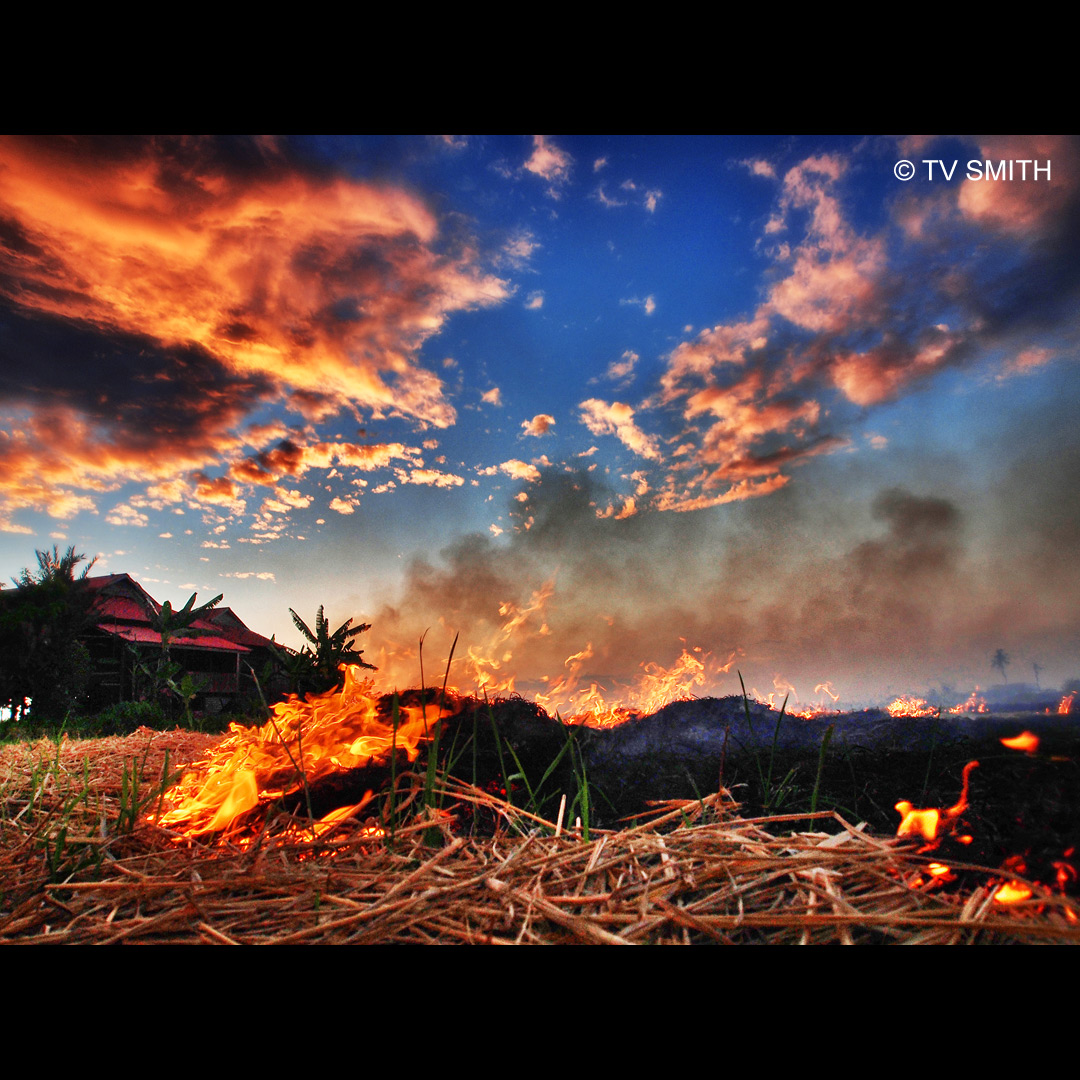
Continuing my journey to the heart of the fire, I finally got as close as I could without scorching the lens. In fact, the heat was so intense I had to back off only after a few seconds. The long walk into the smoky paddy fields under twilight was rewarding. The sunset and flames combined for a rare, beautiful and surreal picture.

I spoke to the farmer involved and he told me he applied selective strip burning in which he burns one ‘keping’ or plot at a time. Unlike large scale land clearing, the fire is isolated, contained and extinguishes quite fast.

It is unfortunate that the rice replanting season coincides with the transboundary haze and the farmers get affected too. As I drove home in the night, I heard on the radio that the Department of Environment announced a ban on open burning.

Olympus OM-D, ISO 200, f7.1, 1/160 sec.

Into The Fire

Burning Issue

Following harvesting of rice, the paddy stalks are burned by farmers to clear the land for next cultivation. This traditional method is also practised in Thailand, India, China, Taiwan, Japan, USA and many other rice-growing countries.

The open burning has become controversial, especially in South East Asia, where it coincides with massive forest and plantation burning that result in seasonal transboundary haze.

At the epicenter of the burning rice fields in the Sekinchan area, the landscape reminded me of the burning oil fields in Kuwait during the Gulf War. On the ground, it wasn’t as dramatic until the sun got lower on the horizon. Earlier in the day, I spotted smoke plumes rising from different directions but the sky remained blue.

The big blockish building on the horizon is a ‘bird hotel’. Known as swiftlet ranching, the bird nests are collected and exported as a delicacy.

Olympus OM-D, ISO 200, f11, 1/2000 sec.

Burning Issue